
To convert APA references to IEEE, identify each source, assign its bracketed number from its first appearance in the manuscript, and rebuild the reference list in that order. Update every author-date citation, including repeats and page locators. This example converts one original paragraph and four real publications, so you can check both sides of the change. We checked the source records and IEEE Reference Guide V3.28.2025 on October 8, 2026, alongside APA’s seventh-edition guidance. Follow the receiving journal or course’s instructions if they specify a different ordering rule.
Build a Source Map Before Changing the List
Save a copy of the APA manuscript. Read from the beginning and record each source when it first appears. Give that work one number and reuse it for later citations. This example numbers sources in their order of first mention.
APA uses author-date citations and an alphabetical reference list. Its list position cannot tell you which work your manuscript cites first. APA’s citation principles explain the original relationship. IEEE’s reference preparation guidance gives the sequential order-of-mention workflow.
The following teaching paragraph is original. Its four sources are real publications, and the final sentence deliberately repeats the first source.
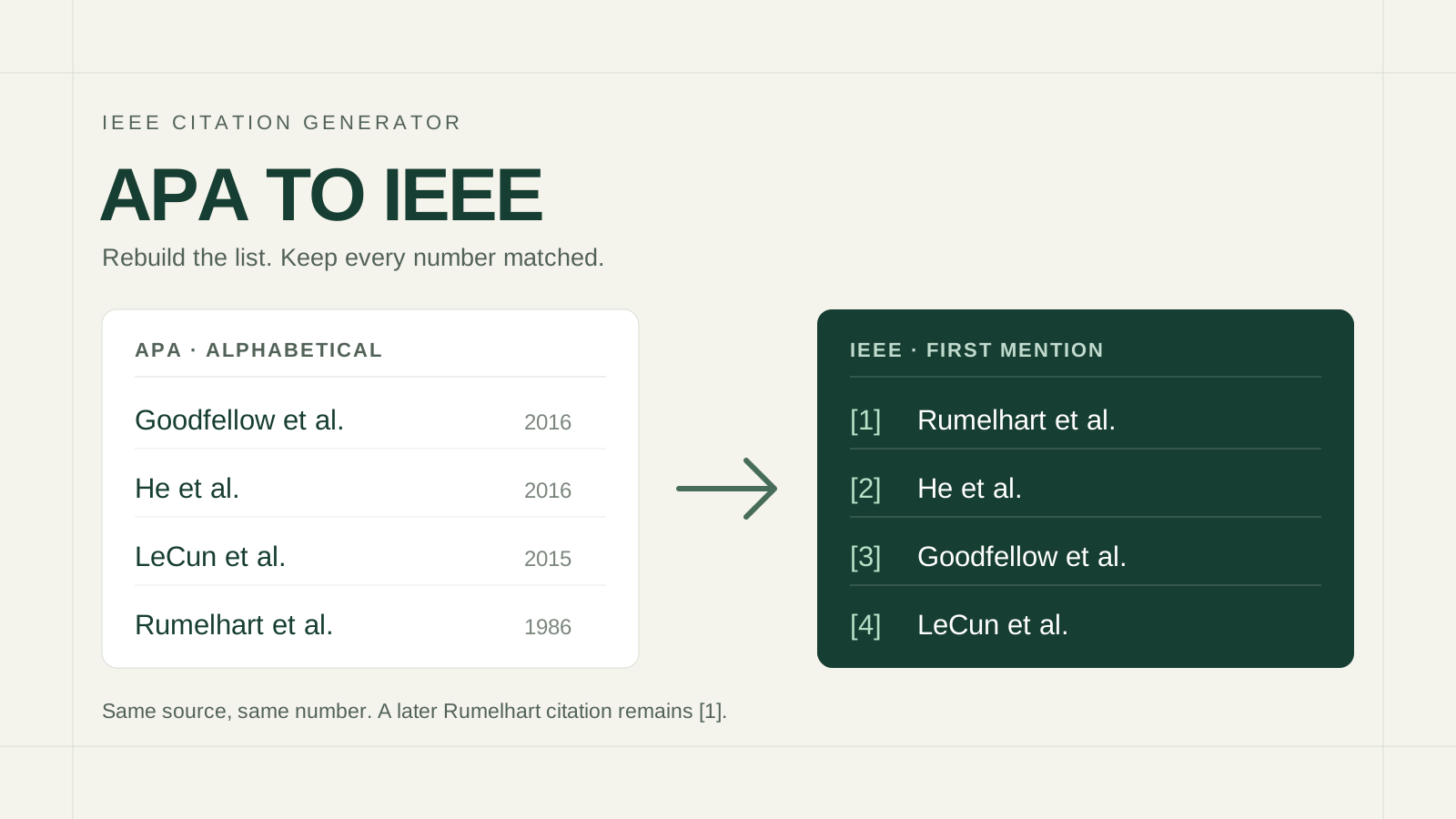
| APA citation identity | Position in APA list | First mention in paragraph | IEEE number |
|---|---|---|---|
| Goodfellow et al., 2016 | First | Third | [3] |
| He et al., 2016 | Second | Second | [2] |
| LeCun et al., 2015 | Third | Fourth | [4] |
| Rumelhart et al., 1986 | Fourth | First, then repeated | [1] both times |
Use a DOI, ISBN, or exact title to distinguish records. Two works here are called Deep Learning, but Goodfellow’s book and LeCun’s journal article need separate entries. Author and year alone can also be ambiguous. Resolve an APA marker such as 2016a against its full reference before removing the letter.
Convert Four APA References to IEEE
These APA 7 entries form the starting list. The book follows its authors’ recommended record; the papers’ authors, venues, pages, and identifiers were checked against their publication records.
Goodfellow, I., Bengio, Y., & Courville, A. (2016). Deep learning. MIT Press. https://www.deeplearningbook.org/
He, K., Zhang, X., Ren, S., & Sun, J. (2016). Deep residual learning for image recognition. In 2016 IEEE Conference on Computer Vision and Pattern Recognition (CVPR) (pp. 770-778). IEEE. https://doi.org/10.1109/CVPR.2016.90
LeCun, Y., Bengio, Y., & Hinton, G. (2015). Deep learning. Nature, 521(7553), 436-444. https://doi.org/10.1038/nature14539
Rumelhart, D. E., Hinton, G. E., & Williams, R. J. (1986). Learning representations by back-propagating errors. Nature, 323(6088), 533-536. https://doi.org/10.1038/323533a0
Rebuild each entry for its source type. Initials move before surnames, article titles gain quotation marks, and journal fields receive labels such as vol., no., and pp.. Keep book and venue titles italicized. The IEEE Reference Guide supplies the book, conference, and periodical-with-DOI patterns used below.
[1] D. E. Rumelhart, G. E. Hinton, and R. J. Williams, “Learning representations by back-propagating errors,” Nature, vol. 323, no. 6088, pp. 533-536, Oct. 1986, doi: 10.1038/323533a0.
[2] K. He, X. Zhang, S. Ren, and J. Sun, “Deep residual learning for image recognition,” in Proc. IEEE Conf. Comput. Vis. Pattern Recognit. (CVPR), Las Vegas, NV, USA, 2016, pp. 770-778, doi: 10.1109/CVPR.2016.90.
[3] I. Goodfellow, Y. Bengio, and A. Courville, Deep Learning. Cambridge, MA, USA: MIT Press, 2016. [Online]. Available: https://www.deeplearningbook.org/
[4] Y. LeCun, Y. Bengio, and G. Hinton, “Deep learning,” Nature, vol. 521, no. 7553, pp. 436-444, May 2015, doi: 10.1038/nature14539.
The APA narrative marker He et al. does not justify shortening the IEEE reference’s four-author list. IEEE’s guide calls for all names up to six authors; above six, it uses the first author followed by et al. Preserve the publication’s author order.
| Field absent or unclear in APA input | Where to check | Result in this example |
|---|---|---|
| Journal publication month | Publisher’s issue date | Rumelhart, Oct. 1986; LeCun, May 2015 |
| Book publisher location | The edition’s publication details and publisher | Cambridge, MA, USA for MIT Press |
| Conference location | Proceedings or conference record | Las Vegas, NV, USA for CVPR 2016 |
| DOI, issue, pages, or edition missing from a shortened entry | Exact publisher record or the copy used | Recover the actual field; do not infer it from the title |
If a field remains unknown after checking the source, flag it for review and follow the target publication’s missing-information rules. Leave unverified details out of your draft.
Replace Author-Date Citations and Preserve Locators
You can keep author names when the sentence discusses their work. Put the number after the name, remove the citation year, and place the bracketed citation inside the sentence punctuation.
Five citation occurrences now point to four entries. The final [1] reuses Rumelhart’s original number. A year that describes a historical event can stay in the sentence; only the author-date citation machinery is being replaced.
A passage locator belongs with the source number. For a passage you checked on page 533, (Rumelhart et al., 1986, p. 533) becomes [1, p. 533]. The reference-list entry still retains the article’s full page range, 533-536. Section and figure locators follow the same source mapping.
For a group such as (Goodfellow et al., 2016; LeCun et al., 2015), use [3], [4]. The current IEEE guide writes each reference number separately, including consecutive numbers. Its sections on citations and parts of references support these forms. For more locator examples, use the IEEE in-text citation guide.
Choose a Workflow and Check the Finished Manuscript
If the document still contains linked citation fields, change the style through the citation manager and refresh the bibliography. A pasted APA bibliography has no links to the citations in your sentences. It needs a source map and a manuscript-wide edit. The Zotero IEEE guide explains linked records and refresh; the Word guide covers a static numbered list.
This site’s “Paste an existing citation” option performs rough field extraction. We checked its parser with the Rumelhart APA entry on October 8. It returned no title, volume, or page range, so the interface could not use that result as a complete parsed record. Use the DOI or fill the fields manually, then inspect the reference.
Prepare records in manuscript order and use the reference list’s Up and Down controls when needed. The IEEE citation generator does not read your manuscript or rewrite its APA citations. Its DOCX export contains static reference text. Reordering that list requires matching changes in the paper.
Try a late edit on a copy. Move the He sentence ahead of Rumelhart’s sentence. He becomes [1], Rumelhart becomes [2], and the other two numbers stay unchanged. The final repeated citation and a Rumelhart page locator must also change to [2] and [2, p. 533]. Replacing one number and then the other with global find-and-replace can overwrite your first change. Work through source identities or temporary markers instead.
- Check the first appearancesRead the manuscript in order, including source citations in captions, tables, and appendices.
- Check every repeat and locatorEach number must still identify the intended work and the cited passage.
- Check the records and listCompare fields with the originals. Resolve duplicates by publication identity, then confirm that every manuscript marker has its matching entry.
- Search for leftover APA markersReview author-year parentheses, year suffixes, and remaining APA separators. Preserve dates that belong to the argument.
- Read the final exportCheck aligned numbers, wrapped lines, italic titles, and the links or DOIs after your last edit.
Questions About APA to IEEE Conversion
Can I convert an APA reference list without the manuscript?
You can reformat individual entries. To assign citation-order IEEE numbers, you also need the first-appearance order from the manuscript. Treat numbers assigned from an alphabetical list as provisional.
What happens to two works labeled 2020a and 2020b?
Give each distinct work its own IEEE number after identifying it from the APA list. Remove the APA year letters from citation markers. Two separate works remain separate even when their authors and publication years match.
Will selecting IEEE in Word convert pasted APA text?
The style setting applies to citations managed by that system. Plain text needs reconstruction. Check which manager owns the document’s citations before changing styles, and keep a backup before replacing or unlinking fields.