
To check IEEE references, compare each entry with its original source, repair the fields, then match every number to the manuscript. Read the passage behind each claim before marking it checked. This IEEE citation checklist works through eight real sources with deliberately flawed draft fields, a corrected list, and a worksheet you can reuse. We checked the publisher and repository records against IEEE Reference Guide V3.28.2025 on October 13, 2026. Follow your journal, conference, or course instructions wherever they specify a different requirement.
Separate Source Identity From Formatting
Open your manuscript beside the reference list and original records. Save a copy before editing. Give each source a working label, such as its DOI or a short title. You will need that label when the bracket numbers change.
Start with the title and author order. Then identify exactly what you used, whether it was a journal article, conference paper, preprint, dataset, or software release. Check that object's fields before applying the receiving publication's style instructions. A DOI that opens successfully still needs this identity check.
The IEEE Reference Guide, sections I and II, covers bracket numbers, author initials, source patterns, and locators. It lists all authors through six and uses the first author with et al. for longer bylines. Keep unfamiliar family names intact. The IEEE citation rules guide explains the basic patterns; this audit applies them to a complete list.
Leave a separate column for the passage that supports your sentence. Bibliographic metadata identifies a publication. Checking an experimental result, definition, or quotation requires reading the relevant passage, including its conditions and qualifications.
Audit a Mixed Reference List
Teaching setup. The eight sources below are real. We deliberately assembled the flawed draft fields for this exercise; they are not errors collected from a user's manuscript. Assume the writer used the 2016 book, version 1 of the preprint, OpenGeoSys 6.5.2, and the 2023 update of FIPS 197.
The table shows only the fields needing repair. The complete corrected list follows it. Its numbers assume first appearances in the order shown; replace that order with your manuscript's actual sequence.
| Entry and draft error | Original evidence | Correction |
|---|---|---|
| [1] Journal Deep learning carries DOI 10.1038/nature16961. | The Nature record names LeCun, Bengio, and Hinton. The draft DOI identifies Silver and colleagues' Go paper. | Use 10.1038/nature14539, with volume 521 and pages 436–444. A working link to the wrong paper fails the check. |
| [2] Conference Deep Residual Learning for Image Recognition is labeled a 2015 journal article. | The CVF proceedings record gives four authors, CVPR 2016, and pages 770–778. | Use the proceedings pattern and 2016 publication year. Keep the conference DOI with this version. |
| [3] Book Deep Learning says “2nd ed., 2017.” | The MIT Press record dates ISBN 9780262035613 to 2016; the authors' citation also uses 2016. | Use 2016 and remove the unsupported second-edition label. An edition must match the copy consulted. |
| [4] Preprint Notes identify Attention Is All You Need v1, but the link ends in v7. | The arXiv history dates v1 to June 12, 2017, and v7 to August 2, 2023. | Keep 1706.03762v1 and its versioned URL together. Cite a proceedings version separately if that is what you read. |
| [5] Software OpenGeoSys 6.5.2 carries DOI 10.5281/zenodo.10890088. | That archive record is 6.5.1. The 6.5.2 record names Naumov first and dates the release June 14, 2024. | Use the 6.5.2 creators, date, and DOI 10.5281/zenodo.11652195. Matching the project name alone is insufficient. |
| [6] Dataset Iris uses 1988 as its citation year. | The UCI record distinguishes its 1988 donation date from the recommended Fisher, 1936 citation. | Use the repository's citation year, credited creator, and dataset DOI. Do not invent a version absent from the record. |
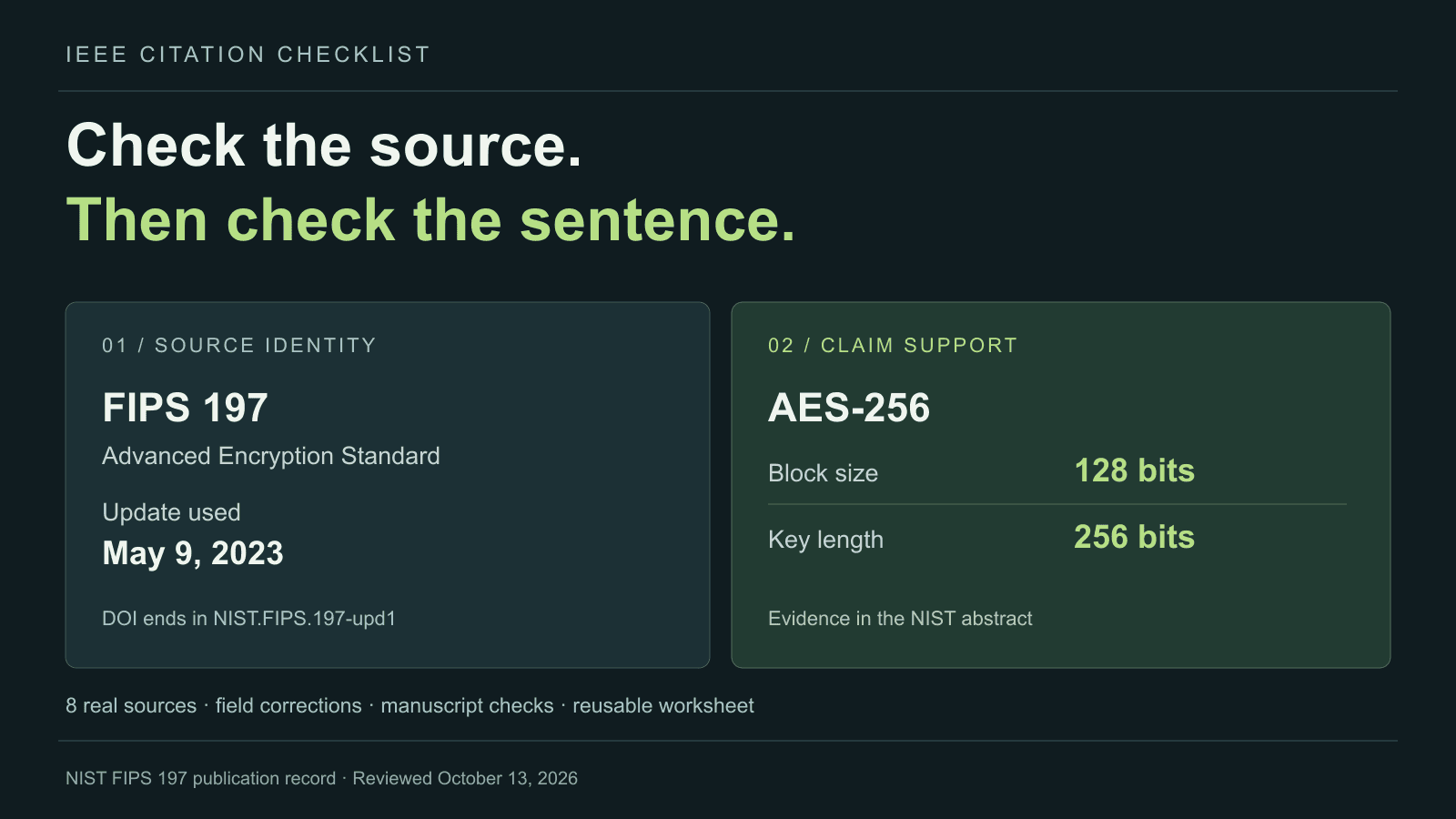
| [7] Standard The writer used the updated AES document but cites only the 2001 edition. | The NIST record identifies the May 9, 2023 update and its 197-upd1 DOI. | Identify the update actually read. NIST says it makes editorial improvements without changing the algorithm. |
| [8] Web page “GitHub, 2026, github.com” stands in for citation-file documentation. | GitHub Docs provides the specific page title and address. Our access date is October 13, 2026. | Use that page and access date. Do not turn the year you visited into a publication year. |
The corrected eight-entry list
The entries below use the linked records and IEEE's source-specific patterns. Keep the full list beside the draft so you can inspect each repaired field in context.
- [1]
Y. LeCun, Y. Bengio, and G. Hinton, “Deep learning,” Nature, vol. 521, no. 7553, pp. 436–444, May 2015, doi: 10.1038/nature14539.
- [2]
K. He, X. Zhang, S. Ren, and J. Sun, “Deep residual learning for image recognition,” in Proc. IEEE Conf. Comput. Vis. Pattern Recognit. (CVPR), Las Vegas, NV, USA, Jun. 2016, pp. 770–778, doi: 10.1109/CVPR.2016.90.
- [3]
I. Goodfellow, Y. Bengio, and A. Courville, Deep Learning. Cambridge, MA, USA: MIT Press, 2016.
- [4]
A. Vaswani et al., “Attention is all you need,” 2017, arXiv:1706.03762v1. [Online]. Available: https://arxiv.org/abs/1706.03762v1
- [5]
D. Naumov et al. OpenGeoSys. (Jun. 14, 2024). Zenodo. (version 6.5.2). [Computer software]. doi: 10.5281/zenodo.11652195. Available: https://github.com/ufz/ogs/releases/tag/6.5.2
- [6]
R. A. Fisher, 1936, “Iris,” UCI Machine Learning Repository, doi: 10.24432/C56C76.
- [7]
Advanced Encryption Standard (AES), FIPS 197 (updated May 9, 2023), National Institute of Standards and Technology, Gaithersburg, MD, USA, May 2023, doi: 10.6028/NIST.FIPS.197-upd1.
- [8]
GitHub. “About CITATION files.” GitHub Docs. Accessed: Oct. 13, 2026. [Online]. Available: https://docs.github.com/en/repositories/managing-your-repositorys-settings-and-features/customizing-your-repository/about-citation-files
For a release mismatch like [5], the software citation walkthrough compares release tags with archive records. For [4], the arXiv citation guide explains how to keep preprints and published papers distinct.
Reconcile Numbers and Claims With the Manuscript
Now read the manuscript from the beginning, including captions and tables. For a venue using first-citation order, record each source's first appearance. Check repeats against the same working label. Search for unused entries, missing numbers, and two entries that identify the same work; resolve them under the submission instructions.
Suppose the first distinct citations in this exercise are [1], [2], [3], [4], [6], [5], [7], [8]. Iris appeared before OpenGeoSys. The mapping is old [6] to new [5], and old [5] to new [6]; the other six numbers stay unchanged. Swap those two list entries and update every occurrence, including locators. A later [5] citing OpenGeoSys must become [6].
In a linked bibliography, repair the source record and refresh the document. For a static list, use a source-to-number map; sequential find-and-replace can change a number twice. The in-text citation guide covers repeat citations and page locators. Matching the highest number to the list length alone will miss a swapped pair.
Claim check. Consider the deliberately incorrect sentence “AES-256 uses 256-bit blocks [7].” The NIST abstract specifies 128-bit blocks for every AES variant; 256 describes the key length. The supported rewrite is “AES-256 uses 128-bit blocks and a 256-bit key [7].” Repairing the reference year would leave the original sentence wrong.
Record Unresolved Items Before Submission
Record what you actually checked. Here, all eight entries have been rebuilt against source records, and the AES block-size statement has been checked against NIST's abstract. Claims attached to the other seven entries still need their own passage checks.
If you can read a publisher's record but cannot access the passage you need, mark the metadata checked and the claim unresolved. Obtain the text through the author or library, choose a source you can inspect, or revise the sentence. A failed lookup also needs investigation before you decide that a publication is nonexistent.
Copy this IEEE citation checklist for each source, or download the audit worksheet. Each checked box should have evidence you can reopen.
[ ] Title and credited authors match the original record.
[ ] Source type, edition, release, or version matches what I used.
[ ] Year, venue, volume, issue, and pages or article number agree.
[ ] DOI or URL opens that exact source.
[ ] Relevant passage supports my sentence and its qualifications.
[ ] Corrections or updates on the source record have been checked.
[ ] Bracket number and any locator match every manuscript use.
[ ] Duplicate and uncited entries have been reviewed.
[ ] Final formatting follows the receiving venue's instructions.

Working source label ____________________
Original record / passage _______________
Unresolved issue / next action __________
Checked by / date ______________________
Use the IEEE Citation Generator to prepare and edit supported source fields. It does not read your manuscript to determine whether a source supports a sentence. Keep specialized software and dataset details under manual review, and check the exported list after your final manuscript edits.
Questions About Checking IEEE References
Does a resolving DOI prove that a citation is correct?
Open its destination and compare the record with the entry. Example [1] has a valid DOI for the wrong paper. Even the right record leaves the cited claim to be checked against the text.
What if two records disagree about a date?
Identify what each date describes. This audit separates a dataset's donation date, a preprint revision, and a standard update from other publication dates. Use the event belonging to the cited object and retain a note explaining the choice.
Can I finish the audit using only a reference generator?
You still need the original sources and manuscript. A formatter can arrange fields; it cannot settle which edition you read or whether a quoted result applies to your sentence.