
An IEEE arXiv citation depends on two checks. Identify the exact arXiv version behind your claim, then see whether a published journal or conference record describes that same work. Keep the preprint and publication fields in their own references.
Read the arXiv Record
Start with the arXiv abstract page for the paper you read. It keeps the title, author list, submission history, arXiv identifier, and any publication details together. A downloaded PDF can be an older revision, so its filename alone cannot tell you which version you have.
IEEE's Reference Guide includes a “Preprint arXiv” pattern. It uses the author, paper title, year, and arXiv number.
[n] J. K. Author, “Title of paper,” year, arXiv:YYMM.NNNNN.arXiv:YYMM.NNNNNv2| Record field | What to check | What it tells you |
|---|---|---|
| Title and authors | Match the manuscript version you read | Paper identity and author order |
| Submission history | Find the version number and its date | Which text was available at that point |
| Cite as | Compare the base ID with the versioned ID | How to link to the current record or a fixed revision |
| Journal reference and DOI | Resolve each publication link to its own publisher record | Whether a separate journal or conference citation is available |
The arXiv page can also display an arXiv-issued DOI. That identifier points to the repository record. A publisher may assign another DOI to a later journal or conference paper. Keep those identifiers attached to the records that issued them.
Decide Which Version Supports Your Claim
Read the sentence in your manuscript, then check the paper version that supports it. The unversioned arXiv abstract URL displays the latest version. Adding a suffix such as v1 identifies one specific revision, and arXiv preserves earlier versions in its history.
The arXiv help page says authors can cite a version with its full identifier, for example arXiv:1512.03385v1. Use that form when a revision matters to your point. A later version may revise a result, add an appendix, or change the author list or title. Those details need to match the version you cite.
A version suffix records sequence in the repository. It does not certify that peer review happened at that stage. Check the journal or conference record for publication status, and open the cited file to confirm it supports the statement in your paper.
Check for a Published Counterpart
Look at the arXiv record's journal reference and DOI fields. Then search the title or resolve the publisher DOI. The publisher record should agree on the paper title and authors and should supply the conference or journal details used in a published-paper citation. For the field-by-field DOI check, see the DOI to IEEE citation guide.
An empty journal-reference field only tells you what that arXiv page lists. It does not establish that the work has never appeared elsewhere. Verify the title with the publisher or proceedings site before deciding that the arXiv entry is the only available record.
| arXiv record reviewed | Publication detail visible there | IEEE arXiv reference draft |
|---|---|---|
| “Scaling Laws for Neural Language Models” | Submitted Jan. 23, 2020. The arXiv page shows arXiv:2001.08361 and no journal-reference line. | [1] J. Kaplan et al., “Scaling laws for neural language models,” 2020, arXiv:2001.08361. |
This is an example of the arXiv-only citation pattern shown by the record we reviewed. Its missing journal-reference line is not evidence about every publisher database or the paper's review history.
When the arXiv paper also appears in proceedings
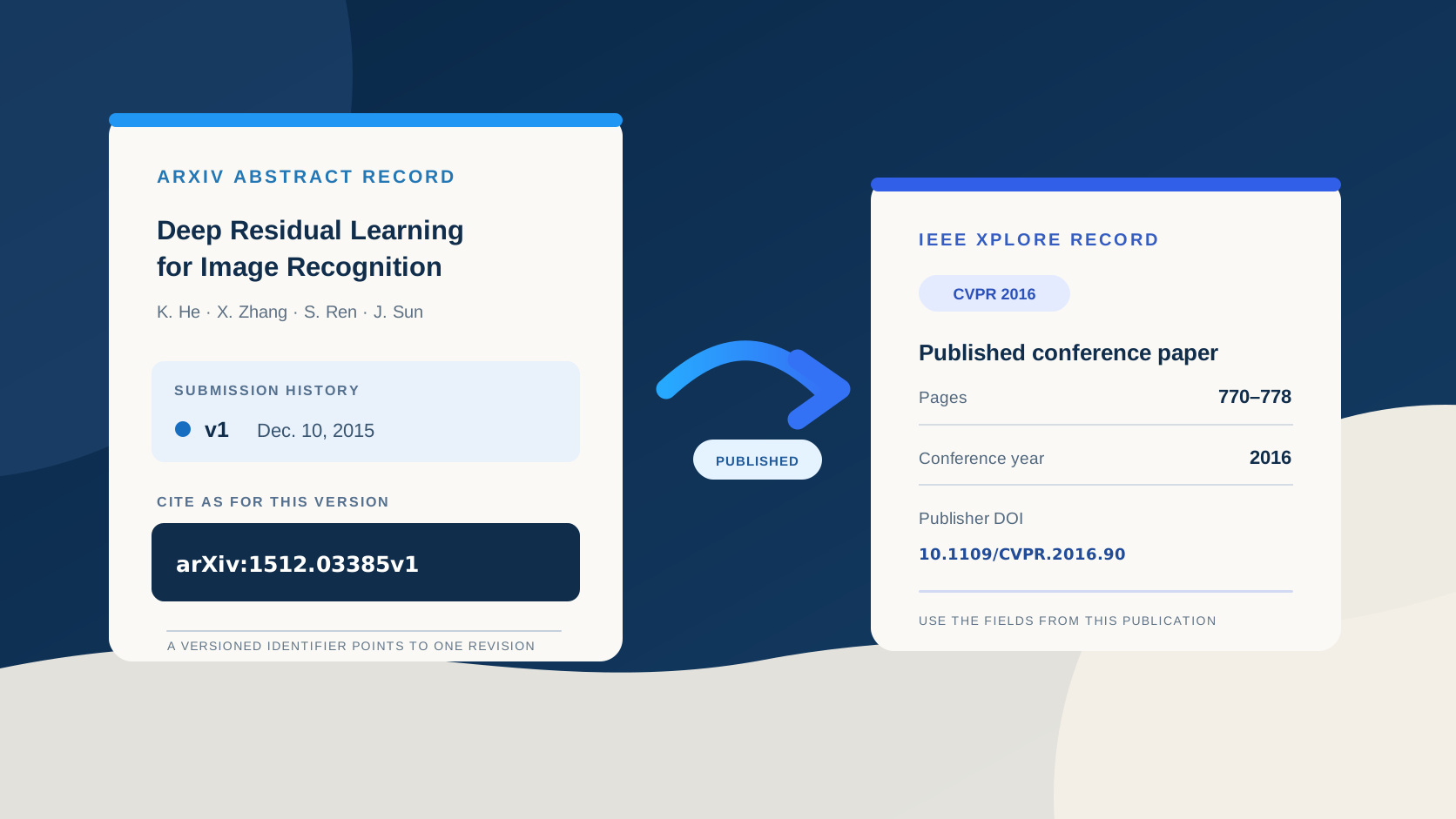
Kaiming He, Xiangyu Zhang, Shaoqing Ren, and Jian Sun's “Deep Residual Learning for Image Recognition” appears on arXiv as version 1, submitted in 2015. IEEE Xplore lists the conference paper in CVPR 2016, pages 770–778, with DOI 10.1109/CVPR.2016.90. The arXiv record also displays its own DOI, 10.48550/arXiv.1512.03385. These identifiers lead to different records.
For more detail on proceedings titles, pages, and publication records, see the IEEE conference paper citation guide.
[1] K. He, X. Zhang, S. Ren, and J. Sun, “Deep residual learning for image recognition,” 2015, arXiv:1512.03385v1.[1] K. He, X. Zhang, S. Ren, and J. Sun, “Deep residual learning for image recognition,” in Proc. IEEE Conf. Comput. Vis. Pattern Recognit. (CVPR), Las Vegas, NV, USA, Jun. 2016, pp. 770–778, doi: 10.1109/CVPR.2016.90.Choose the line that points to the text you used. When the final proceedings paper supports your statement, use its published record. When the claim concerns a detail present only in the arXiv revision, cite that version. Cite both only when the comparison itself matters, and give them separate reference numbers.
If the counterpart is a journal article that has an Early Access record, use the publication date and DOI shown by the publisher. The IEEE Early Access citation guide explains how to handle a paper whose final volume or pages have not been assigned.
Keep the Citation Internally Consistent
Build each reference from one record at a time. An arXiv preprint entry uses the preprint pattern. A journal entry gets its journal, volume, issue, pages or article number, publication year, and publisher DOI from the journal. A conference entry gets the proceedings title, year, pages, and DOI from the conference record.
| Before you copy | Check |
|---|---|
| Paper identity | Title and author order match the version or publication cited |
| Version | The arXiv ID includes vN when a specific revision matters |
| Publication status | A publisher or proceedings record confirms the venue details |
| Identifiers | The arXiv ID and any publisher DOI point to the records named in the entry |
| Numbering | The bracket number follows your manuscript and stays attached to this source |
The generator's Online type can hold a general source version and URL. It does not have a dedicated IEEE arXiv reference pattern, so compare its output with the Reference Guide and keep the exact arXiv ID and any needed vN suffix attached to your citation. Use Journal or Conference for a confirmed published record. The IEEE source-type guide covers the general reference patterns.
Have the published paper details?
Choose Journal or Conference to match the publisher record, then check the title, year, pages, and DOI before copying.
Open the citation generatorFrequently Asked Questions
How do I cite an arXiv preprint in IEEE?
Use the IEEE Reference Guide's arXiv preprint pattern with the author, title, year, and arXiv number. Add a version suffix when the cited revision matters, then follow the instructions for the publication receiving your manuscript.
Should I include v1 or v2 in an IEEE arXiv citation?
Include the suffix when readers need the exact revision you used. arXiv supports version-specific identifiers. The IEEE guide's sample pattern shows the base arXiv number, so check the target venue when it gives more specific instructions.
How do I cite an arXiv paper published in a journal?
Cite the record for the text that supports your claim. Use the journal or proceedings entry when its published version is the one you relied on. Use an arXiv version when the claim depends on that revision.
Should I list both versions?
Give the two records separate entries when you rely on both or compare their contents. A reference that combines the arXiv identifier with publication fields from another record can point readers to a version that never had those details.
Does arXiv posting confirm peer review?
No. The arXiv page identifies a repository record and its version history. Check a journal or conference publisher record when peer-reviewed publication status matters.