
An IEEE technical report citation needs the report behind the file. Check its authors or responsible institution, issuing organization, report number, version, date, and stable online record before you format the reference.
Confirm That the Document Is a Technical Report
An IEEE technical report citation starts with the work, not the fact that you downloaded a PDF. Look for an agency, laboratory, university, or company record that calls it a report, technical memorandum, special publication, research report, or white paper. Record the title, author or organization, date, and report or series number.
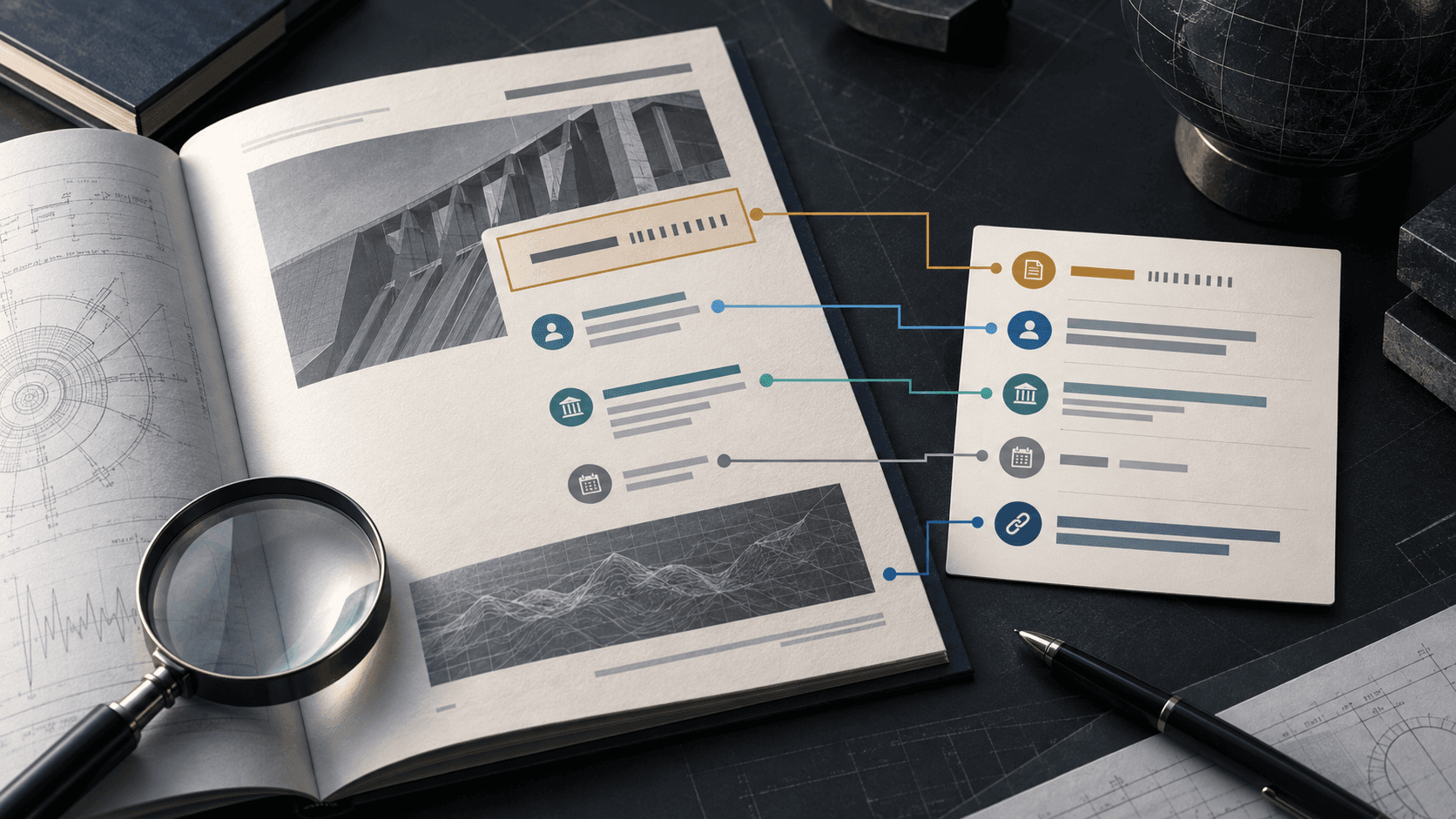
The IEEE Reference Guide places the author and report title first, followed by the company or institution, location, report number, and date. Online reports also need a truthful route back to the source. Treat the pattern as a checked starting point because a venue may vary its house style.
If all you have is a file, use the PDF citation guide to identify the source first. Then focus on its authors, institution, number, version, and locator.
Read the Cover and Publication Record
Report metadata is often split across the cover, title page, revision block, repository record, and DOI landing page. Read those pieces together: a clean-looking citation can still point to the wrong revision if you copy only the first search result.
| Field | Where to look | What to keep |
|---|---|---|
| Author | Byline, title page, or official record | Named people in order, or the responsible institution when no people are named |
| Report title | Cover and publication record | The issued title, including a subtitle when it distinguishes the work |
| Institution and place | Publisher line, title page, or agency record | The company, laboratory, agency, or university and the city, state, and country when required |
| Report number | Cover, series label, catalog record, or DOI metadata | The exact series and number, such as NIST SP 800-94 |
| Date and version | Publication date, revision history, or version block | The date and revision that support the claim in your paper |
| Online locator | DOI, repository record, or official document page | A stable DOI or URL that resolves to the same work or version |
The NIST reference-format page lists the author, title, publisher, place, series number, revision, and DOI when those fields apply. Its display uses NIST's author-year format. For IEEE, reuse the verified fields in IEEE order.
Build the Reference From Verified Fields
These two public records show why an IEEE technical report citation needs a field check. The first is an institution-issued report with a series number. The second is a company white paper with named authors and no report number shown on its official page.
Institution report with a report number
The NIST publication record lists K. A. Scarfone and P. M. Mell, the title Guide to Intrusion Detection and Prevention Systems (IDPS), the NIST SP 800-94 identifier, a 2007 publication date, and DOI 10.6028/NIST.SP.800-94.
Authors | K. A. Scarfone and P. M. Mell
Institution | National Institute of Standards and Technology
Location | Gaithersburg, MD, USA
Report number | NIST SP 800-94
Date | Feb. 2007
[1] K. A. Scarfone and P. M. Mell, “Guide to Intrusion Detection and Prevention Systems (IDPS),” National Institute of Standards and Technology, Gaithersburg, MD, USA, NIST SP 800-94, Feb. 2007. Accessed: Sep. 21, 2026. [Online]. Available: https://doi.org/10.6028/NIST.SP.800-94Company white paper without a report number
The Google Research page lists nine authors, Google as the organization, the 2025 date, and identifies the work as a white paper. The page does not show a report number.
Authors | Y. Sushko, C. Muya, J. Novak, C. Madison, R. Critides, B. Kamber, N. Vempati, J. Wiesner, and D. Deutscher
Organization | Google
Location | Mountain View, CA, USA
Report number | None shown on the official record
Date | 2025
[2] Y. Sushko, C. Muya, J. Novak, C. Madison, R. Critides, B. Kamber, N. Vempati, J. Wiesner, and D. Deutscher, “Our Approach to Protecting AI Training Data,” Google, Mountain View, CA, USA, 2025. Accessed: Sep. 21, 2026. [Online]. Available: https://research.google/pubs/our-approach-to-protecting-ai-training-data/The contrast is useful. The NIST line carries a series and report number because the issuing record supplies them. The Google line keeps the named authors, company, year, and online record, then stops. Adding “Report No. 2025” would make the citation look complete while changing the source metadata.
Check the Online Locator and Final Number
For an online technical report, use a DOI when it resolves to the report. Otherwise use the official repository or publication page. A landing record can preserve the number and version better than a PDF.
- Source identityIs this an issued report, a white paper, a data sheet, a standard, or a different work inside a PDF?
- AuthorsDo the names or responsible organization match the official byline, and are sponsors kept separate?
- Number and versionDid you copy the report series, number, volume, supplement, or revision exactly from the record?
- DateDoes the date belong to the version you used rather than a page update or download date?
- LocatorDoes the DOI or URL resolve to the same report, and does it follow the instructions of the venue receiving your paper?
- In-text numberDoes the bracket number match the reference list and stay unchanged when the same report is cited again?
This site currently has no dedicated Technical Report source type. Use the manual workspace to keep a checked draft, then review the institution, report number, date, and locator before copying or exporting. The IEEE citation rules checklist covers the final numbering and metadata review.
Have the report open?
Start with its cover and official record. Keep the report number visible, then compare the finished line with the guide used by your journal, conference, or department.
Open the manual citation workspaceFAQ
How do I cite a technical report in IEEE?
Use the named author or responsible organization, report title in quotation marks, issuing company or institution, location when required, exact report number, and publication date. For an online report, add access information and a stable DOI or URL in the target venue's required form.
What if a technical report has no report number?
Leave the report-number field out. Keep the author, title, institution or company, date, and stable locator. Do not turn a year, file name, DOI, or “White Paper” into a report number.
Should I cite a report as a website because I found it online?
No. The hosting route does not change the source type. Cite the report when your claim comes from the report, and cite a webpage when the webpage itself is the source of your claim. The IEEE website citation guide covers that separate case.