
For an IEEE citation with multiple authors, preserve the byline order and use given-name initials before each family name. The current reference-list rule retains all authors through six; longer lists use the first author and et al. Check your submission’s instructions before applying that cutoff. We compared IEEE Reference Guide V3.28.2025 with five publication records on October 9, 2026. The examples include a six-author paper, an eight-author paper, a surname prefix, a compound surname, and a group author. The formatter checks show which names need manual attention before export.
Separate In-Text Names From Reference Authors
A reference number identifies one work, however many people wrote it. You can write The database was introduced in [1]. without naming anyone in the sentence. If you name the researchers, the current guide uses Deng et al. [1] for three or more authors. The reference entry still has its own author-list requirement. See Section I.A of the IEEE Reference Guide and our in-text citation guide.
Alphabetizing coauthors would change the credited order. Preserve the publication’s byline, including the first author. Proceedings editors and a corresponding-author label identify other roles; neither tells you who should lead the paper’s reference.
Preserve Family Names and Published Initials
IEEE author initials abbreviate given names. Keep the family name intact. The linked records below establish the name forms. Nationality alone cannot tell you how to split a name.
| Source credit | Checked author segment | Field decision |
|---|---|---|
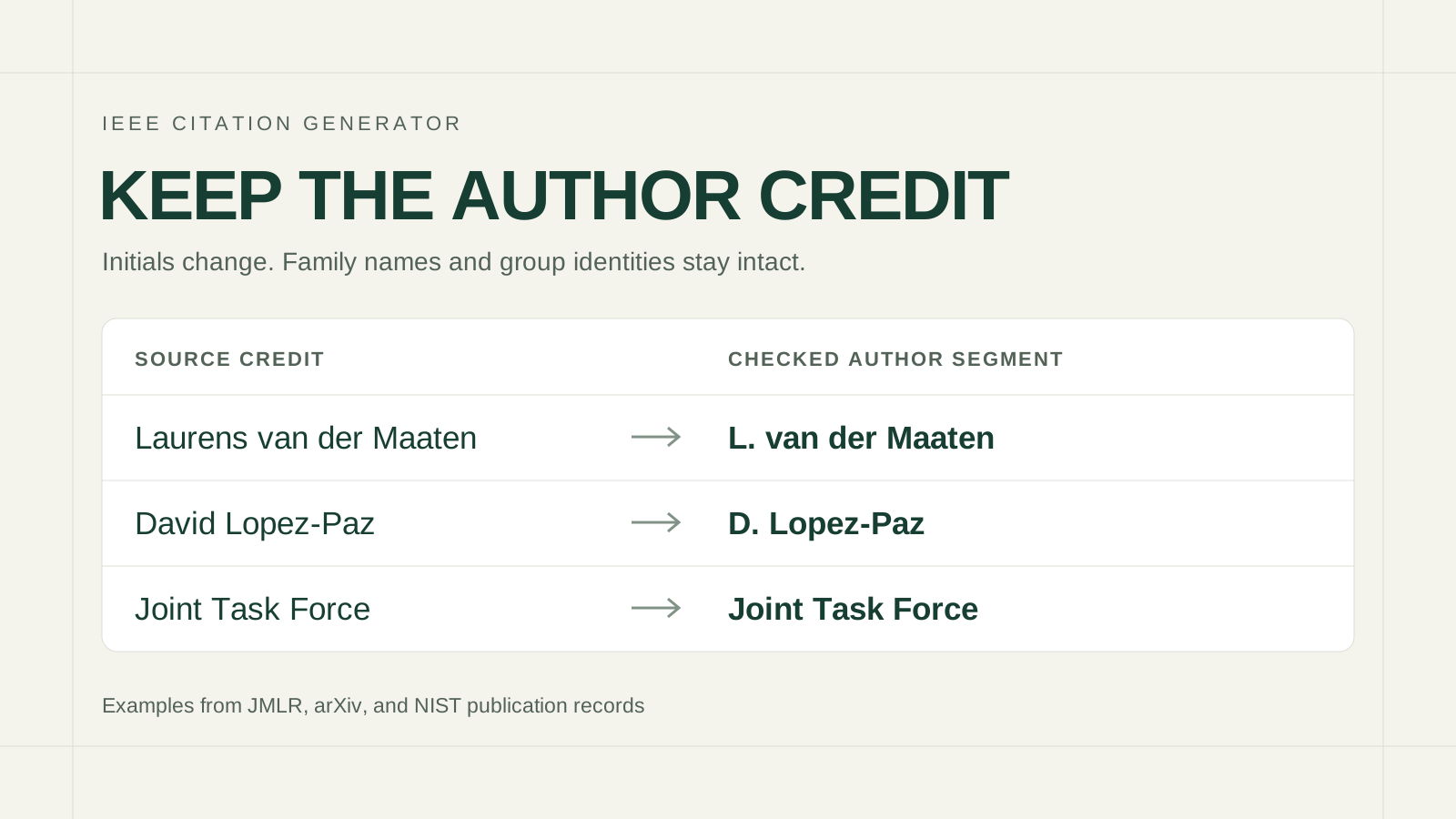
| Laurens van der Maaten | L. van der Maaten | Keep the published family-name prefix together. |
| David Lopez-Paz | D. Lopez-Paz | Retain both parts of the hyphenated surname. |
| Li-Jia Li | L.-J. Li | The hyphen belongs to the given name; Li is the family name. |
| Aidan N Gomez | A. N. Gomez | Retain the supplied middle initial without expanding it. |
| Joint Task Force | Joint Task Force | A group credit stays a group name. |
JMLR’s t-SNE record gives Geoffrey Hinton without a middle initial. Use G. Hinton for this record. Another publication may supply more initials. Likewise, the linked arXiv record spells Lopez-Paz without an accent. Preserve that credit instead of silently substituting a spelling from another profile.
An import can obscure these distinctions. The ImageNet DOI metadata we retrieved on October 9, 2026 placed the entire strings Kai Li and Li Fei-Fei inside family-name fields, without given-name fields. Compare the visible byline and publisher’s recommended citation before converting a structured field into initials. The DOI lookup guide explains the wider record check.
Check Group Authors and Imported Records
For an IEEE corporate author citation, establish who receives the author credit. NIST’s record for SP 800-53 Revision 5 lists Joint Task Force under Author(s). NIST is the publishing institution. Keep those roles separate; the organization hosting a document does not automatically become its author.
We tested this site’s author formatter on October 9, 2026. In the manual Authors field, separate people with semicolons. Entering Laurens van der Maaten; Geoffrey Hinton produced L. V. D. Maaten and G. Hinton. Entering van der Maaten, Laurens; Hinton, Geoffrey preserved the family name. Preformatted L. van der Maaten; G. Hinton also worked.
The same check turned Joint Task Force into J. T. Force. The current editor has no explicit group-author switch. Correct that author segment in the final exported text, or use a reference manager with a literal organization-name field. With eight personal names, the preview added a comma before et al.; remove that extra comma to match the author segment shown above.
Open the manual citation editor with the original record beside it. Count the credited authors before shortening the display. Check each family name and the author order in the preview, then inspect the copied or exported reference. If a returned record already ends with et al., recover the full byline before calling the author list complete.
Questions About IEEE Reference Authors
Does a four-author reference use et al.?
Under the current general guide’s full-list rule, retain all four. A venue or course can specify a different rule, so check the instructions attached to your submission.
Can I enter et al. as another author?
Keep it out of the stored person list. It abbreviates omitted names. If an import contains only a shortened byline, retrieve the original author record before treating the list as complete.
Should I expand an author’s initials?
Only when the source record establishes the full name. Keep suffixes and name particles attached to the correct person, and check the required punctuation in your target guide.