
To cite a dataset in IEEE, open the data record you used and capture its creators, publication date, complete title, version, repository, and DOI or stable URL. A related paper may need its own reference when it supports a different part of your work.
Identify the Data Object You Used
An IEEE dataset citation should lead a reader to the data behind your analysis. Start at the dataset's repository record, then check the files or subset you actually used. A paper describing the collection may explain the method, but its DOI identifies the paper. IEEE's Reference Guide, section E gives datasets their own pattern and asks for a persistent locator where one is available.
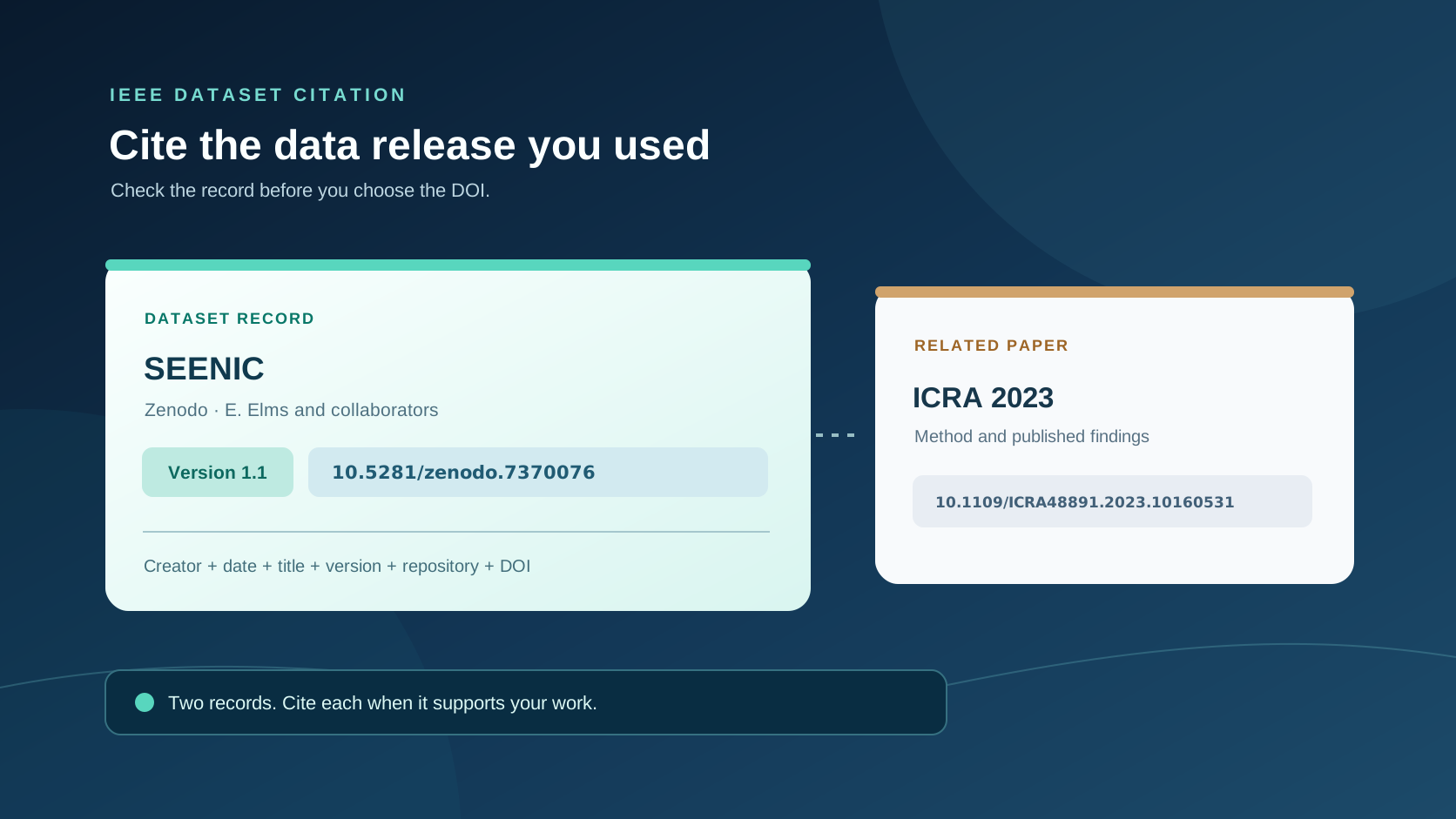
Open the DOI rather than reading it from a search snippet. On the landing page, look for a resource type, creator list, publication date, version, repository, and file inventory. The SEENIC record on Zenodo is marked Dataset and lists event-camera data files. It also links a conference paper. Those are two related research objects with different identifiers.
Read Creators, Repository, Date, and Version
IEEE's dataset section names the responsible individuals or organization, publication or dissemination date, complete dataset title with a version when applicable, distributor, and DOI or URL. It asks for a retrieval date when the title and locator do not identify the exact instance used. The DataCite data-citation guidance explains why a data record should be linked to the publications that use it; it does not set IEEE punctuation.
| Field | SEENIC on Zenodo | Iris on UCI |
|---|---|---|
| Data object | SEENIC event-camera dataset | Iris classification dataset |
| Credited creator | E. Elms, M. Jawaid, Y. Latif, and T.-J. Chin | R. A. Fisher |
| Record date | Published Oct. 17, 2022 | Repository citation uses 1936 |
| Version shown | 1.1 | No version listed |
| Repository | Zenodo | UCI Machine Learning Repository |
| Dataset DOI | 10.5281/zenodo.7370076 | 10.24432/C56C76 |
The UCI Iris page presents a useful date check. It says the dataset was donated to UCI in 1988, while its displayed recommended citation uses Fisher and 1936. The citation year comes from that recommendation; the donation date describes a different event. UCI lists no version for this record, so a data citation should not invent one.
Copy names in the order supplied by the dataset record. Keep the repository as the distributor even when the authors have university affiliations. If you used only a named file or a filtered subset, preserve that detail in your methods or data-availability statement. A DOI for the whole record may not identify your exact subset.
Keep Dataset and Article DOIs With Their Own Records
The SEENIC dataset page links “Towards Bridging the Space Domain Gap for Satellite Pose Estimation using Event Sensing,” published in the 2023 IEEE International Conference on Robotics and Automation. The repository also asks academic users to cite that paper. The paper DOI, 10.1109/ICRA48891.2023.10160531, resolves to the proceedings work; 10.5281/zenodo.7370076 identifies the dataset release. The paper's title, venue, pages, and year belong in a conference reference, while the data version and Zenodo identity belong in a dataset reference.
| Use in your manuscript | Record to inspect | Identifier |
|---|---|---|
| State which SEENIC files supported an experiment | Zenodo dataset, version 1.1 | 10.5281/zenodo.7370076 |
| Discuss the published pose-estimation method | ICRA 2023 paper | 10.1109/ICRA48891.2023.10160531 |
Follow the dataset authors' citation request and the instructions of the venue receiving your manuscript. Separate references make sense when you use both the released data and the paper's method or findings. A paper reference alone leaves the exact data release unidentified; a dataset reference alone does not locate the argument you took from the paper. The DOI lookup guide shows how to confirm what a DOI actually names.
Document the Exact Release You Used
SEENIC's Zenodo record labels itself version 1.1 and has the record DOI 10.5281/zenodo.7370076. Its all-versions concept DOI is 10.5281/zenodo.7214230. Zenodo's version guidance says a new file version receives a separate record and persistent identifier. For reproducible analysis, cite the version you obtained. The concept DOI is useful when you mean the series of versions as a whole.
A version label and a DOI do different work. The label tells the reader how the repository describes the release; the DOI resolves to its record. Confirm that both point to the same release before writing the line. Keep the file names and any preprocessing choices with your analysis notes. Zenodo can change record metadata after publication, so the version DOI should be checked against the file inventory, not treated as a substitute for it.
If the repository offers only a changing URL, look for a dated snapshot, accession number, release tag, or archived query. When the cited title and locator still do not fix the instance, add the retrieval date under IEEE's dataset guidance and explain the extraction date or time range in your methods. Do not assign a made-up version number to an unversioned record.
Build and Check the IEEE Dataset Reference
The following are working IEEE references based on the two live repository records. The bracket numbers show manuscript order only; replace them with the numbers assigned by your paper. The version appears in the SEENIC title field for clarity, as IEEE asks for the complete title including a version when applicable.
[1] E. Elms, M. Jawaid, Y. Latif, and T.-J. Chin, Oct. 17, 2022, “SEENIC: dataset for Spacecraft posE Estimation with NeuromorphIC vision, version 1.1,” Zenodo, doi: 10.5281/zenodo.7370076.[2] R. A. Fisher, 1936, “Iris,” UCI Machine Learning Repository, doi: 10.24432/C56C76.[3] M. Jawaid, E. Elms, Y. Latif, and T.-J. Chin, “Towards bridging the space domain gap for satellite pose estimation using event sensing,” in Proc. 2023 IEEE Int. Conf. Robotics and Automation (ICRA), 2023, pp. 11866–11873, doi: 10.1109/ICRA48891.2023.10160531.IEEE also provides a dataset pattern using a DOI resolver URL and another using a website address. Follow the target journal or instructor when it specifies one form. For a dataset with a DOI, the compact doi: form above follows the guide's DOI example. If you use a plain URL, its online pattern adds [Online]. Available:. Check your final citation against the IEEE reference checklist before submitting.
- Resolve the identifierConfirm that the DOI opens a dataset record rather than a describing paper.
- Match the releaseCheck creators, title, repository, publication date, version, and file inventory.
- Describe your sliceRecord files, subset, extraction date, or query in your methods when the DOI covers more than you used.
- Review the outputApply the receiving venue's rules and make sure the bracket number matches the manuscript.
This site has an Online source option, but it does not promise a complete dataset-specific IEEE format. Keep the repository record open and finish a data reference manually when its creator, version, or DOI fields do not fit. For software archived alongside data, the GitHub software guide handles releases as a different source type. The website guide's short dataset example helps when a search result first appears to be a web page.
Frequently Asked Questions
What belongs in an IEEE dataset citation?
Use the credited creator, published or disseminated date, complete dataset title, version when present, repository or distributor, and DOI or stable URL. Add the retrieval date when the title and locator do not identify the exact instance used, subject to your venue's instructions.
Should I cite a dataset or the paper about it?
Cite the data record for data you analyzed. Cite the paper when you rely on its method, interpretation, or findings, and follow the data creators' stated citation request. Separate entries are useful when both objects support your work.
Which Zenodo DOI should I use for a versioned dataset?
Use the DOI attached to the release you used when another researcher needs the same files. A concept DOI identifies the collection of versions and may lead to a later release.